Go-to-Market Strategy
Summary
Ibby launches with shareable role/candidate agents to prove distribution + build match-ready inventory, then repeatedly turns on matching per archetype once (BYR/MAR)[#byr-mar] and coverage thresholds show reliable conversation-ready shortlists.
Objective
Solve the cold-start / flywheel problem of a dual-sided marketplace by launching single-party "agents" that deliver value independently, generate real-world usage data, and accumulate durable marketplace inventory—then enable profile matching once candidate supply reaches critical mass.
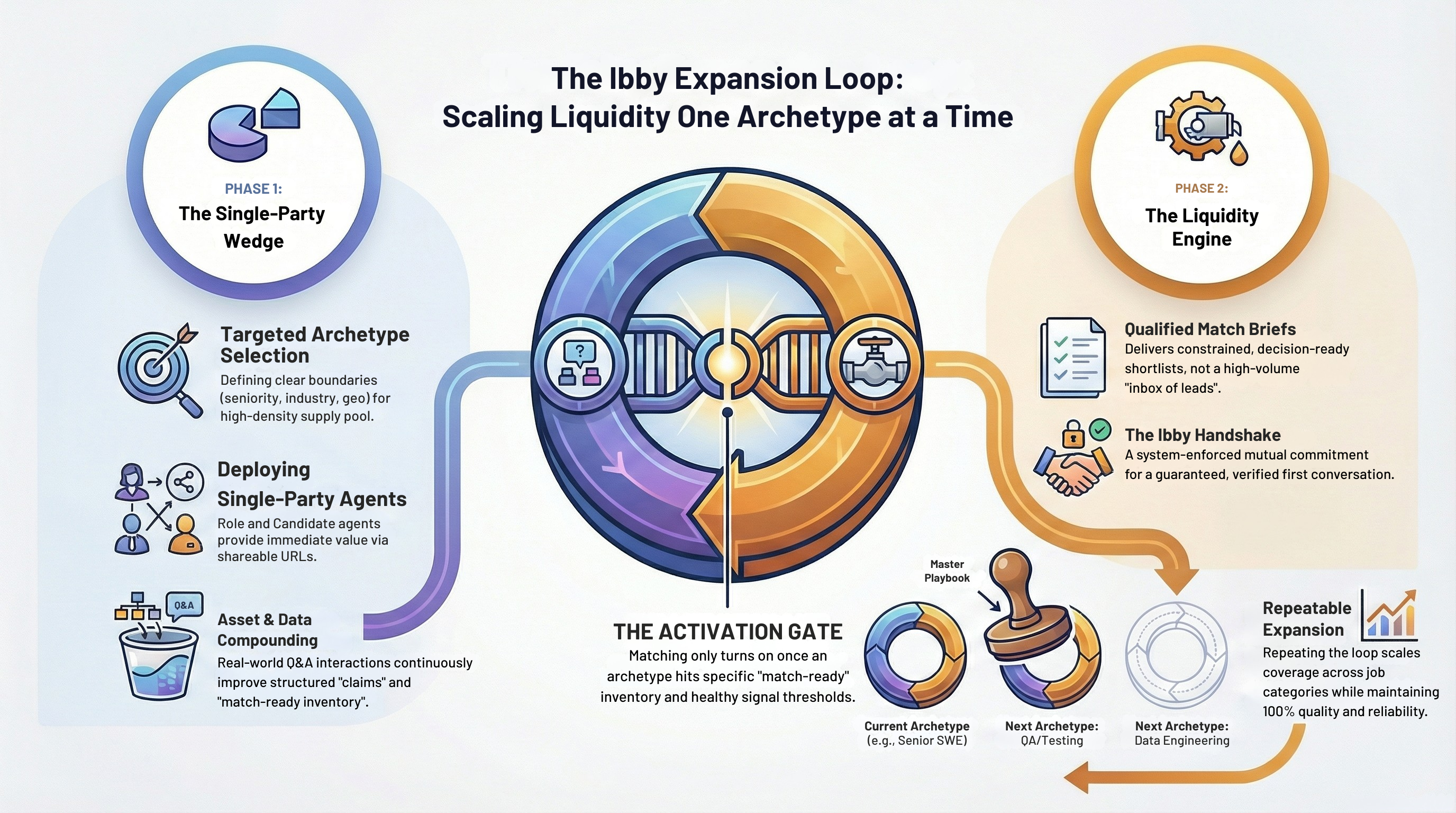
Critically, Ibby treats market expansion as a repeatable Phase 1 → Phase 2 loop per role archetype (not a one-time platform-wide conversion). Each archetype becomes its own liquidity "unit" that can be proven, activated, and scaled.
Core primitives being validated
Claim-Based Fit Modeling
- Both sides submit basic information, then answer clarifying questions driven by previous submission and learned behavior.
- The system produces structured claims about a person/role and embeds them to enable precise matching, weighting, and filtering across semantic signals.
- See entry in (Core Mechanics)[/core-mechanics.md#claim-based-fit-modeling] for further details.
Agent Interrogation
- Agent Interrogation: Each agent can be "interrogated" by the public: people ask questions, the agent answers from claims + authored context.
- When the agent can't answer confidently, it generates follow-up questions for the author.
- Authors answer follow-ups asynchronously; the agent improves continuously.
- See entry in (Core Mechanics)[/core-mechanics.md#agent-interrogation] for further details.
Archetypes: how Ibby defines liquidity and expansion
The Archetype is Ibby's standardized role category defined by shared evaluation dimensions and a shared candidate supply pool.
Archetypes are the unit of measurement for:
- "critical mass" inventory thresholds
- matching viability
- Phase 1 → Phase 2 activation gates
Initial Target Archetype
Software engineer
- backend/full-stack
- mid to senior level
- B2B SaaS
- US/Canada time zones
- remote-friendly
This archetype is intentionally chosen because:
- it has large candidate supply
- evaluation criteria are relatively standardized
- remote-friendly roles are common and searchable
- willingness to adopt new workflows is high (post-seed to growth-stage startups)
Phase 1: Single-party launch
Phase 1 is designed to:
- generate durable inventory (agents + claims)
- validate distribution via existing behaviors (job posts, applications, outreach)
- validate interrogation + follow-up loops as repeatable usage
Service distribution channels
- Landing pages + SEO
- LinkedIn networking + targeted ads (including niche communities)
- Reddit/community ads
- Job boards and other placements that can host/point to agent URLs
Agent URLs
-
Unique URL per agent
- Company agent may cover one role
- Candidate agent covers one individual
-
Agent links are designed to be forwarded in Slack/email and embedded in job postings/applications.
Shareable agent URLs (with surface attribution)
- Role agents embedded in job posts and shared in applications
- Optional link tags ("Copy link for job post/application/outreach/referral") used to attribute which surfaces generate reach and engagement
Companies: Company/Role Agent
- Company creates an agent, optionally with multiple role "threads."
- Candidates can ask anything about the company/role/process.
- Defaults: open answers for non-blacklisted topics; optional user-controlled gating.
- PII is excluded by default; salary sharing is configurable.
Candidates: Professional Profile Agent
- A candidate creates a shareable profile agent that can discuss background, skills, history, and role-relevant questions (including common interview-style prompts).
- Companies can interrogate the candidate agent before scheduling interviews, improving signal and reducing wasted calls.
- Not "spammable" — agent is not an outbound blast mechanism; it's a high-signal artifact shared in-context (e.g., with an application or recruiter outreach) to enable deeper evaluation asynchronously.
Virality loop
- If a question triggers a clarifying follow-up and the company later answers it, the system can optionally collect the questioner's contact info and notify them when the answer is available.
- Agent landing page contains Ibby branding and a direct link to "create your own agent."
Feedback loops
why Phase 1 matters
Phase 1 produces real-world signals that improve both primitives:
- Claim quality improves because clarifying questions are driven by what real people ask.
- Coverage improves because authors fill gaps over time, asynchronously.
- Matching readiness improves because structured claims become more complete and comparable before matchmaking is turned on.
P1 Metrics
Agents -> inventory + distribution
Distribution + interrogation funnel
Primary metrics that prove agents are getting shared through real workflows and generating real interrogation.
| Metric | What it measures | Window |
|---|---|---|
| External reach | Unique non-owner visitors per agent | 7-day |
| External engagement | % of non-owner visitors who submit >= 1 Q&A prompt | 7-day |
| Engagement depth | Non-owner Q&A prompts per agent | per week |
Loop health guardrail
This ensures the interrogation loop actually closes and the agent improves over time (vs stagnating).
- Follow-up SLA
- % of follow-up questions resolved within 72 hours (via response or claim update)
- tracked continuously
- Goal: 80%
Phase 1 success criteria
These thresholds define "the Phase 1 loop is working" for Archetype 1.
| Criterion | Description | Threshold |
|---|---|---|
| External reach | Average number of unique non-owner visitors per agent (7-day) | 3 |
| External engagement | % of agents receiving >= 1 question (7-day) | 25% |
| Follow-up SLA | % resolved within 72 hours | 80% |
Critical mass
Phase 1 -> Phase 2 bridge
We enable Phase 2 matching for an archetype only when Ibby can reliably produce Qualified Match Briefs for that archetype while meeting SLA stipulations.
Critical mass metric
- Match-ready inventory
- # of match-ready profiles, per archetype
- rolling 30 days
- Goal: 2,000-3,000 (viable minimum ~1,000)
Match-ready profiles have sufficient coverage to evaluate fit across the archetype's core dimensions (not just a resume upload).
Activation criteria
- Shortlist reliability: Ibby can generate 4 Qualified Match Briefs (QMBs) within 7 business days of a company agent for that archetype reaching match-ready status (per archetype).
- Supply quality, not just volume: "Match-ready" profiles meet a minimum structured-claim completeness threshold of >= 80% against the archetype's required evaluation dimensions (e.g., coverage in >= 8 of 10 required dimensions).
- Repeatability requirement: All activation criteria must hold week over week for 4 consecutive weeks (per archetype), measured on a minimum weekly sample size of:
- >= 10 new or updated company agents declaring intent for that archetype (or equivalent "standing role intent" objects), and
- >= 50 QMBs delivered generated by matching those company agents against candidate agents, and
- across >= 5 distinct companies.
We Enable matching for an archetype once a role can consistently receive 4 qualified Match Briefs within 7 business days, supported by stable BYR and MAR, with sufficient claim completeness to sustain credible mutual affirm.
BYR + MAR
core conversion rates that determine liquidity
Phase 2 viability depends on two rates that connect inventory size to reliable outcomes.
Together, BYR and MAR allow Ibby to forecast whether current inventory can produce 3–5 conversation-ready briefs per role without manual sourcing.
BYR (Brief Yield Rate)
The % of match-ready profiles in an archetype that can become a Qualified Match Brief for a specific role once constraints and weighting are applied.
- Early target assumption (Archetype 1): BYR ≈ 5–10%
MAR (Mutual Affirm Rate)
The % of qualified Match Briefs that reach mutual "affirm interest" within a defined time window.
- Early target assumption: MAR ≈ 20–30%
Phase 2: Two-party matching
Phase 2 turns Phase 1 inventory into a structured marketplace: Ibby begins producing and operating real matches between company agents and candidate agents.
Phase 2 is designed to:
- Activate matching only where Phase 1 has proven sufficient critical mass (per archetype)
- Convert match-ready inventory into Qualified Match Briefs (QMBs) with measurable engagement (interrogation, affirm interest)
- Operationalize the Handshake as a reliability layer that drives fast, human-to-human first conversations
- Validate repeatable outcomes loops (which matches progress, where they fail, and why) to improve modeling and guardrails
What gets added in Phase 2
- Matching engine + scoring: Ibby compares claim-based profiles across the archetype's core dimensions and produces ranked candidates.
- Qualified Match Briefs (QMBs): the unit of delivery that summarizes fit, gaps, and next-best questions to ask.
- Context interrogation loop: either side can ask targeted follow-ups to resolve uncertainty before committing.
- Handshake workflow: mutual affirm interest triggers scheduling + interview windows with guardrails to prevent ghosting and abuse.
How Phase 2 is distributed
Phase 2 expands distribution by attaching value to the same surfaces Phase 1 already validated:
- Company-side: job posts, outbound outreach, referrals, and internal hiring workflows that point to company agent URLs
- Candidate-side: applications, inbound interest, recruiter intros, and referrals that point to candidate agent URLs
Match surfaces
- Match-ready company agents are eligible to receive QMBs for the archetype.
- Match-ready candidate agents are eligible to appear in QMBs for that archetype.
- Both sides still share the same agent URLs, but Phase 2 adds a new outcome: a brief becomes a handshake when both parties affirm interest.
P2 Metrics
Matching → outcomes + liquidity
Success Criteria
| Criterion | Description | Threshold |
|---|---|---|
| Shortlist reliability | # of qualified Match Briefs delivered within 7 days of role intake | 3-5 |
| Agent engagement | % of delivered QMBs to receive 1 or more context interrogation questions within 3 business days of delivery | 60% |
| Handshake conversion | % of Match Briefs that reach mutual "affirm interest" within 7 days | 20% |
| Intro completion | % of mutually affirmed matches that complete a first conversation within 10 days | 75% |
Trust guardrail
- Employer follow-through rate (no-ghost)
- % of mutual affirms where the employer completes the promised first conversation
- Goal: 85%
Liquidity / role coverage
- Coverage ratio
- Median match-ready candidates available per role intake, per archetype), plus p25
- Track p25 to avoid "average-only" success
- Goal: 60-100 (~30 minimum; > 150 comfortable)
Iterative Phase Transitions
repeatable loop by archetype
Ibby does not rely on a single platform-wide "flip" from Phase 1 to Phase 2. Instead, Ibby repeats the same loop as it expands:
1) Phase 1 (for Archetype X): build match-ready inventory + prove interrogation and follow-up behavior 2) Activation gate (for Archetype X): confirm critical mass + coverage ratio + stable loop health 3) Phase 2 (for Archetype X): enable matching and measure shortlist reliability, BYR, MAR, and intro completion 4) Scale: expand acquisition and repeat for the next archetype
This produces a controlled expansion model where Ibby can grow liquidity systematically without sacrificing match quality.
Instrumentation notes
how metrics are measured
Ibby's Phase 1/2 metrics are designed to be auditable from first-party logs without requiring visibility into external ATS systems or private email threads. Where "sharing" cannot be observed directly (copy/paste into an application form), Ibby measures downstream outcomes (external landings and engagement) and attributes them to distribution surfaces via optional link tagging.
Identity: owner vs non-owner
Each agent has a canonical owner (creator) and all sessions/events are classified as:
- Owner: authenticated creator session (or access token associated with the agent owner)
- Non-owner: any session not associated with the owner (including anonymous visitors)
All "external reach / engagement / depth" metrics are computed using non-owner sessions/events only.
Uniqueness and session counting
To avoid "sessions ≠ people" problems, we track two related measures:
- Unique visitor: de-duplicated by a first-party cookie + user agent fingerprint (and optionally hashed IP as a secondary signal)
- Session: a time-bounded interaction window (e.g., 30 minutes of inactivity ends a session)
Primary reporting uses unique visitors where possible; sessions are used for secondary diagnostics.
Distribution surface attribution (optional link tags)
Ibby provides optional "Copy link for …" buttons that append a lightweight query param or short-code:
?src=job_post?src=application?src=outreach?src=referral
Notes:
- These tags do not need to identify the recipient or platform.
- If a link is shared without tags (manual copy from address bar), it still counts toward reach/engagement, but is recorded as
src=unknown.
Primary channel mix metric:
- Channel mix: % of non-owner landings by
srcover a rolling 7/30 day window
Event taxonomy (what we log)
At minimum, Ibby logs the following events with agent_id, timestamp, owner/non-owner, and src tag:
Traffic + reach
agent_view(agent page loaded)agent_session_start/agent_session_end
Engagement
prompt_submitted(non-owner submits a Q&A prompt)response_generated(agent produces an answer)followup_generated(agent generates a clarifying question for the owner)
Loop closure
followup_resolved(owner answers follow-up OR updates structured claims to address it)claims_updated(structured claim set materially changed; see definition below)
Matching (Phase 2)
role_intake_completebrief_created(Match Brief generated)brief_qualified(passes minimum quality threshold)affirm_interest_employeraffirm_interest_candidatemutual_affirmintro_initiated/intro_completed(first conversation confirmed)employer_no_ghost(employer meets handshake expectation within time window)
Definitions for "meaningful" and "match-ready"
To prevent vanity metrics and spam inflation, Ibby uses operational definitions:
Meaningful engagement
- A non-owner session counts as "engaged" if it includes ≥ 1
prompt_submitted - Optionally, require ≥ N seconds on page OR ≥ 2 interactions to exclude accidental bounces
Prompt quality guardrails (anti-spam)
- Prompts from the same visitor can be rate-limited
- Prompts below a minimum length or obviously spam can be excluded from "depth" reporting
- Repeated identical prompts from the same visitor can be de-duped
Match-ready profile
A profile is "match-ready" for an archetype when:
- Required claim dimensions for that archetype meet a minimum completeness threshold
- Constraints (timezone/work mode/seniority band) are present
- The profile is active in the last 30 days (viewed, updated, or engaged)
Ibby reports inventory by archetype and by completeness tier (e.g., 60% / 80% / 95% coverage).
BYR and MAR measurement (Phase 2)
BYR (Brief Yield Rate)
- Computed per role intake:
qualified_briefs / match_ready_candidates_in_scope - "In scope" is defined by hard constraints + archetype membership at time of intake
MAR (Mutual Affirm Rate)
- Computed per role intake (or cohort):
mutual_affirms / qualified_briefs - Time-windowed (e.g., within 7 days) to reflect real marketplace cadence
Privacy and compliance notes
- Ibby can operate with anonymous non-owner sessions (no login required to interrogate).
- PII is excluded by default from public agent outputs; sensitive fields are controlled by policy and author settings.
- Link tags (
src) do not contain recipient identity—only coarse distribution surface classification.
Reporting cadence and stability requirement
Because early usage can be noisy, "working" thresholds are evaluated as:
- rolling 7-day metrics for reach/engagement
- rolling 30-day metrics for inventory
- "stable week-over-week" defined as meeting success criteria for 4 consecutive weeks before activating Phase 2 for a new archetype